

Nix Du

Learning the World While Surviving: Green Hell’s Metroidvania-Style Open World and Environmental Storytelling

1100 words | 3 minutes | Spoilers Survival games got me obsessed again lately. A potential survival game designer role urged me to revisit this genre, so I went through a selection one by one: Green Hell, Rust, SCUM and No Man’s Sky. None of them made me feel like I was on a mission. In fact, these highly-rated survival games drew my attention as a player as much as a designer. Among these 4 games, I have spent the most amount of time playing and dissecting Green Hell, an open-world hardcore Survival game for both singleplayer and multiplayer. Environmental storytelling in Metroidvania-like levels Green Hell’s canon storyline is composed of scattered pieces of memories, revealed little by little to the player behind a thick curtain of Amnesia. In the game, the player plays as explorer Jake Higgins, with a goal to find his wife Mia in the jungle. During the exploration, Jake and Mia will have frequent conversations over a Walkie Talkie; but soon the player will find everything suspicious: Jake seems to have been through the same search long time ago, and Mia’s words doesn’t make sense at all sometimes. Only at the end of the game will the player realize that Jake has gone insane because his past discoveries led to the death of millions including Mia, and was actually talking to himself the whole time. What’s unique about this narrative? It breaks down a main storyline and 3 short tales into pieces and smoothly weaved them into an open-world game play. The player will not be forced to do any specific task to recover these stories.  Aside from the storytelling, Green Hell’s Metroidvania-style map cut the map into several free-to-explore sections, with natural barriers in between that requires the discovery of a certain tool to pass through. This design prevents the player from getting spoiled before exploring the previous chapter thoroughly, further enhancing the feeling of “exploration”. Furthermore, with each tool added to the player’s backpack, the player will be able to unlock more optional points of interests and build camps in more remote locations. This mechanic gave the player a feeling of “leveling up” without an experience system nor a skill tree, keeping the difficulty and hostility of every map section around the same level. After ~50 hours in Green Hell and a handful of notes, I finally felt confident to examine its worldbuilding and narrative thoroughly. Before examining its pros and cons, let’s go over a list and a database I put together first. Jake’s illusion of Mia’s calls Jake recalls his past achievements through documents Green Hell’s playthrough, divided by sections S0 – Tutorial The player expects a two-people expedition, while learning the basics. The player now has almost no attatchment to Mia. Jake and Mia’s camp Cinematic (teleports the player into the next section) – About missing the evacuation S1- Abandoned small village The player spend most time learning to survive around a single camp, unaware of how big the world is. The player believes Mia is somewhere in the jungle. Backpack (ritual note, map) Ritual place (unlocks the stone gate) Stone gate & cinematic (unlocks the next section) – About the second visit to the jungle S2 – The cartel establishments The player realizes the others’ existence and starts to suspect Mia’s honesty. The player learns to track and move between multiple camps. Discoveries of multiple modern structures can be found here. Dock Drug factory (Finding a Jeep track leading to the abandoned Jeep) Jeep (Finding the fuel to enter the gold mine) Gold mine (Finding the grapple to access the ritual place “Lambda 2”) Wahara tribe Plane crash Ritual place “Lambda 2” (Unlocks the stone gate) Stone gate, canyon & cinematic (Unlocks the next section) – About how Mia had cancer S3 – Anaconda Island & Airstrip The player spends less time building upon repositioning multiple times.Upon Mia’s disconnection, Jake’s sanity and Mia’s intentions will be doubted, raising the player’s curiosity and concern. Anaconda island Airstrip Metal hut (Acquiring climbing gear for the deep well) Deep well (Acquiring scuba diving gear for the underwater tunnel) Underwater tunnel (Leading to the next section) S4 – Wetland & Omega camp The player needs minimal effort camping. The player learns that Jake had been here with a team, and feels guilty that Jake messed up their mission.Finding the cure solely depends on if the player thinks about the foreshadowing of catchable frogs. Omega camp Ritual place “Lambda 1” (Unlocks the stone gate) Stone gate & cinematic (Getting into the enclosed cave) – Memories about curing cancer – Memories about the spread of an unknown deadly virus Enclosed cave (Acquiring the grappel gun needed for the next section) S5 – Yabahuaca’s land The player doubts Mia’s fate upon seeing the destroyed village. Almost no time is spent camping here, as an ending can be felt approaching.The player feels strongly attached to Mia and is very concerned about her potential death. Jake’s camp (now abandoned, hinting a surprisingly long time has passed since tutorial) Yabahuaca main village Ritual place (Activates the cinematic) Cinematic (Unlocks the ending) – Mia gets the virus, heartbroken – Yabahuaca massacred by the cartel because of the virus – Jake’s expedition in Omega camp, going insane, getting amnesia – Leaving before the expedition, seeing Mia in ventilation Ending Neutral and Bad ending, depending on if the player finds the cure for the virus or not. Green Hell’s events, sequenced by chronologics or gameplay Please navigate the following database by scrolling horizontally and vertically. Change the sequencing style with the droplist above the table. The pros and cons of scattered environmental storytelling Prior to Green Hell, I experienced strong environmental storytelling in The Witcher 3 (open-world) and the Bioshock series (linear). From my point of view as a player, it has the following benefits: Accessibility. The player doesn’t have to follow a pre-arranged sequence and is free to visit them at any point. Efficiency. Environmental storytelling can be mass-produced modularly in the
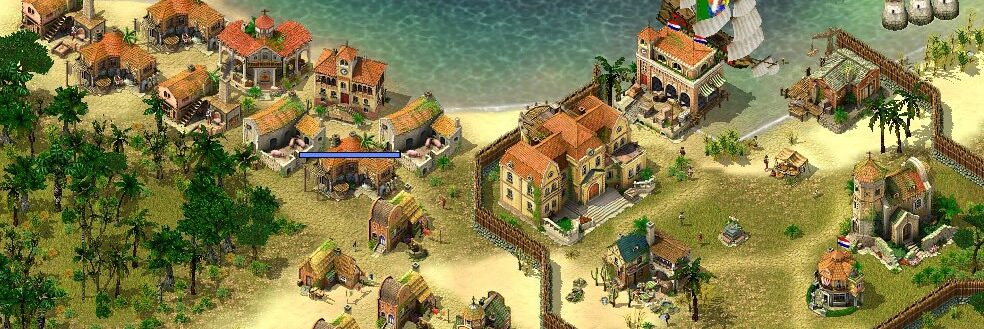

Politics in Business: Port Royale’s Staggering Economic Systems

1300 words | 3 minutes Around fall 2020, when our new Game Design professor Alexander King introduced us to the system design world, I became interested in strategy games and trading games. I’m normally not a number person, but I still did the maths to beat the game. After spending 25 hours playing Port Royale, I spent another couple of hours reviewing my gameplay and summarizing the intriguing economy systems in the game. Overview Port Royale 2 is a real-time strategy game of real historical events inspired background stories. The story happened in the Caribbean colonial island in the 17th century, and the player, being a small ship’s owner, will be doing trades and other profitable actions under this chaotic and intense political situation, in order to make as many profits as possible. There is no maximum nor minimum number of a player’s assets, hence there is no clear winning/losing state of the game. However, very similar to incremental games, with more assets the player has, more game content will be unlocked, driving the player to seek more profits. The game has an extremely complicated system, with dozens of noticable flows. Stage 1: Horizontal growth and buy-and-sell economy The game starts with most of the player activities unpermitted by the government, so the player will get familiar with the game in a rather simple system: The player travels between towns, buys cheaper items, and look for another town where the price of the item is higher. The bigger amount of one product a player buys from a town, the stock of that product in the town decreases, and the price will be increasing dramatically. The same rule applies to selling items: The more you sell to a town, the less you earn from each trade, due to the shrinking of demand. This is one of the core mechanics of the game. It’s inspired by real-life trading, and can prevent players from spamming trades repetitively. However, the stock and pricing system in each town is are not totally dependant on the player’s actions. There are AI ships, plantations, and factories in each town, generating a varying amount of stocks; there is also a population value in towns that consumes these goods. With each town having its specialties of production, the player can memorize the best locations to purchase different items, and hence figure out an optimal trading route. The more cash the player has, the more valuable products the player can buy and sell, making even more profit. The player will grow horizontally in the market, until its stock covers every type of product. Sailing around and trading is rather risk-free and easy to learn, but the productivity is very limited due to the unpredictable prices in each town, and the maximum storage on the player’s convoy. In order to make more profit, besides buying more ships from the shipyard, the player can produce its own goods by building in towns. Stage 2: Vertical growth and Produce-and-sell economy Before building in a town, the player needs to purchase permission from the authority, which will be more expensive as more permissions are bought. Besides cash, the building will also cost wood and bricks, which could be bought in as goods. After inducing labors, building a residential area, a warehouse, and a production building, the production process will start automatically. Usually, the player needs to start with a primary production estate, and then move to the secondary industry. Since each town only has certain types of buildings available to construct, the player will eventually need to expand into multiple towns, and constantly transfer goods between them. For example, Cartagena is a garment-producing town, and Santa Marta is a cotton-producing town. If the player wants to produce a large number of garments, a crossover industrial chain between the two towns is necessary. With this chain of production, the player can achieve vertical dominance in the town’s market. Just like in real life, producing one’s own goods is always more profitable than buying from other merchants. The ones being both the supplier and the retailer can always make money than either of these two. After the player has enough total assets to level up, the governor will be happy to talk to you and give you tasks, out of which some are war-related, and some are not. Normally, a player would not immediately purchase the letter of marque and start sea battling, because a large number of sailors, ships, cannons, weapons, and ammo are required in the convoy to win a battle, not to mention the disastrous result of losing one. Starting off with more peaceful tasks, such as negotiation, looking for survivors, and supplying selected towns with goods, the player can gain lots of rewards, plus the reputation needed to hire sailors. Stage 3: Battling and plundering After all the necessary gears for a sea battle are purchased by the player, it will be the time to start conquering. With permission from the letter of marque, the player is able to attack weaker convoys of enemy country’s convoys, claim their properties, and collect governmental rewards. However, the battle needs lots of experience, since the controls have made it incredibly hard to aim and dodge. Winning a sea battle is a huge boost to the player’s total assets worth, but losing a battle could also be a nightmare. The player will lose all the ships involved in the battle, which in most situations means losing most of the property. Sea battles are good ways to boost a player’s financial status. It’s also essential for future developments since enough enemy slew will give the player permission to attack and claim an enemy country’s town. In order to successfully defeat the original armies in the town, the player’s convoy needs to be very massive and well-equipped. Attacking governmental towns is almost impossible, but smaller towns are generally easier to conquer. With fewer benefits too, of course. Stage 4: Automatic profiting Claiming a town will generally take

Solarpunk Academy – NYC Pop-up Show

Yooo! If you’re reading this, I just finished the pop-up graduation show in the Parsons DT building. If you didn’t know about Solarpunk Academy before, you probably came to this page because you played the game earlier today! To be honest, I was super insecure about my project before the show, because Solarpunk Academy is just a Pixel Art Visual Novel among all the AR, VR installations and other cutting-edge projects. I was afraid that people will see Solarpunk Academy as “less cool” than the surroundings.  But you guys showed an enormous amount of love! My section got so crowded that I had to open up a new player terminal with my personal laptop. During the 3-hour span, more than 20 people finished the 20-minute alpha demo and signed up for my update newsletter. I am truly grateful for all the encouragement and support! What’s Next? I will fix the bugs on the Alpha release, put out a better Alpha version and work on the Beta release. The beta release of Solarpunk Academy will include: 

Solarpunk Academy – Alpha 1.0

Features After the Pop-up Show in Parsons, the Alpha Test of Solarpunk Academy is released! It includes: Known bugs Tips: If you can’t proceed to a new scene, press enter! Beta Version Expectation

Is Interactivity Art? An Analysis of Video Games’ Exclusive Artistic Value

2000 words | 5 minutes Introduction As digital technology has become more and more advanced, what virtual programs can provide to the mass market of consumers has been greatly enhanced. Video games, a form of entertaining computer program that was in constant expansion of both scale and variety over the past decades, have also become more capable of initiating a hybrid, interactive experience. This hybrid experience video games bring to the player can sometimes be so delicate, that it’s considered art by many people around the world. Being both an art student and a game designer, the researcher is always interested in investigating such a polarizing topic. However, in this essay, the focus is not on the artistic value of video games — which has been done by many others long before. Instead, the researcher will analyze the art of systems in video games. After field researching various genres of video games, the researcher aims to prove that interactivity in video games can be artistic, and can differentiate video games from any other forms of art. This essay’s main focus will be on making connections between video games, responsive systems, interactivity, and art. Video games and art To get through the connections between the four factors addressed above, I will first analyze the relationship between video games and traditional art forms. Despite being a well-discussed topic, it is still worth mentioning because it’s an essential part of my thesis statement. Just like how literature, music photography, and theater art are integrated into the art of filmmaking, video games can contain many different art forms. Thanks to the flexibility of digital media, almost every art form in existence can be merged into a video game. Universally speaking, most video games employ the same principles as traditional canvas arts: perspective, form, value, and more, to create a window into an imaginative world[1]. Depending on the media and genre, a video game can be composed with multiple forms of art, including the ones that are thought to only exist in real life. For example, in the platformer game Limbo, the story is delivered without the characters saying a line[2]. Although animated digitally, the scenes and gestures truly show the artists’ mastery of theater arts. Only combining several other art forms can certainly make a computer program artistic, but is not enough to make a new type of art. Take film making as an example again — movies were once considered a “series of photography” in its early stage[3], but later became an important art medium thanks to the technique of montage. Digital media, while able to joining all traditional art forms together, needs a unique core technique enough to define itself as an independent form of art. This means that the technique should be capable to give a non-art digital program artistic value without relying heavily on certain other art styles. From my understanding of game design and art, this core element is the design of interactive systems. Video games and interactivity Until this day, people still haven’t come to an agreement on what the first video game is. There are several candidates, including Tennis for Two[4], OXO[5], and Spacewar![6]. However, these programs all share a similarity: they are all interactive. At least one method of input is required to exist in the program since the very start of video game history. Unlike radios and TVs, instead of using the input to switch between multiple streams of content, video games respond to an input by directly changing the content itself, no matter if the change is displayed, broadcasted, or stored in the database. It was this kind of immediate and preservable feedback that made video games “interactive”. However, to make an interactive computer program into a video game, a designer also has to meet the other fundamental factors of game design: Goals, rules, problem-solving, entertainment, etc.[7] Just like a board game needs its rules to be executed when being played, a video game also needs the program to gather all the inputs and logically organize them to be playable. Therefore, in a video game, there are not only singular immediate interactions but also complex, systemic interactivity. Spacewar! OXO Tennis For Two Previous Next But what is complex and systemic interactivity? Complex systems are systems that do more than the sum of each part of them, and they are everywhere in our daily lives[8]. In fact, we rely on complex systems to live. We live under the laws of physics, the earth’s ecosystem, our nation’s constitution, and many more systems that give feedback to our actions. Our living quality is optimized by complex systems too, such as vehicles, artificial chemicals, electronics, and the main topic of this paper — video games. Viewing from the most fundamental aspect, most complex systems in a video game can be explained with programming languages and electronic routings, but they don’t represent systemic interactivity. The ones on the user’s end do, such as inventory, messaging, and battling. These systems are closer to people’s common sense, hence are easier to interact with. All of these systems are composed of individual objects’ properties and behaviors, as well as their relationships with other objects in the scene.[9] By observing these patterns, the player gets to understand the complex systems under the game’s surface, and ultimately develop their own tactics and strategies of playing.[10] Along the way, the player will also get familiar with the aesthetics and the narrations of the game. A summarization of development and playing process of a video game. However, these two elements are not as essential to a video game as interactivity. Input and output are an inseparable part of video games, while there are plenty of games out there that has other parts of them taken away. MUD games such as Zork[11] does not have any asset besides their logo, and vector multiplayer games such as Agar.io[12] contains minimal assets and no narration at all. A pioneer arcade game located in Brooklyn, New York called Line wobbler uses an LED